A Light Beyond the Hill: Fr. Godfrey Mullen, OSB, Becomes Third Saint Meinrad Monk Named Bishop
Wednesday, July 1, 2026
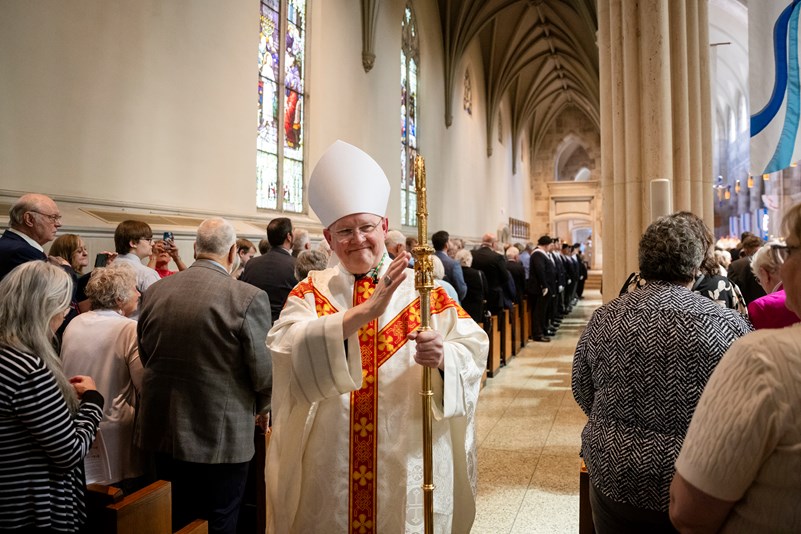
As a young monk, Fr. Godfrey Mullen, OSB, sat in a community meeting where the conversation turned to the dwindling enrollment at Saint Meinrad College. One of the older monks grew agitated as the discussion went on, until he finally stood and walked to the microphone.
“If we exist only for ourselves,” he said, “then we are not living the monastic life that Benedict envisioned, and we should be ashamed of ourselves. We must be a light on a hill so that others might come to know the glory of God.”
“I was really impressed by the beauty and the passion of what he had to say,” Fr. Godfrey says. “Starting then, I knew Saint Meinrad was about more than what happens on that hill.”
That conviction would carry him through 14 years of parish ministry—and, this spring, to his ordination as bishop of the Diocese of Belleville, IL, only the third Saint Meinrad monk in the archabbey’s 172-year history to be named a bishop.
The Appointment
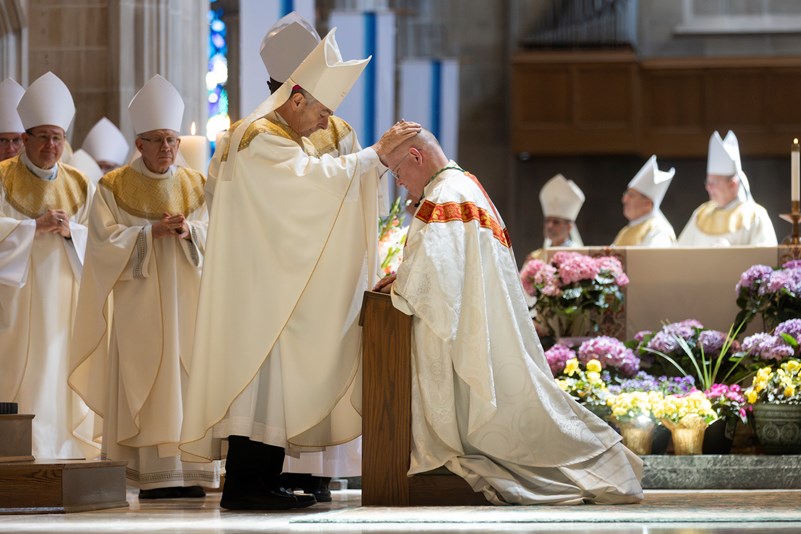
Pope Leo XIV named Bishop Godfrey the 10th bishop of Belleville on March 13, 2026. On May 1, more than 1,000 people gathered at the Cathedral of St. Peter, where Cardinal Blase Cupich, archbishop of Chicago, installed him. Bishop Godfrey’s quick to point out that the ordination itself wasn’t really about him.
“This is a celebration for a lot of people who have helped make me who I am,” he says. “It’s not my big day. It is a day for countless people who have had the courage to walk this path with me, and together we have made a difference in the Church. That’s the beauty of community. That’s what we’re celebrating.”
He didn’t see this appointment coming. Cardinal Christophe Pierre, the apostolic nuncio to the United States, called him directly with the news. He was caught off guard for two reasons: it is uncommon for a priest to be named bishop of his home diocese and uncommon for someone already serving as a diocese’s administrator—a role Bishop Godfrey had held since May 2025—to be elevated to lead it permanently.
In that same call, Cardinal Pierre gave him something to hold onto.
“He summed up what my responsibility as a monk who becomes a bishop is,” Bishop Godfrey says. “‘Remain a monk—be a man of community, be a man of prayer, and be a man of simplicity.’ That will not only help me remain who I am and give me consolation in the life that I’m now living, but also, it’s a gift that I bring to the Church in southern Illinois.
Planting the Idea
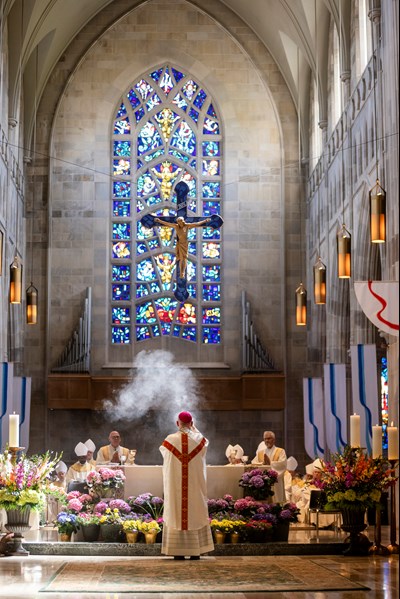 Bishop Godfrey has a long-standing relationship with the diocese. He was born in Alton, IL, and moved as an infant to Salem, in the Diocese of Belleville, where he was raised.
“These are people that I’ve known since I was nine months old,” he says. “These are people whose relationship with Christ has fascinated me since I was a little boy.”
In sixth grade, a Felician sister from Chicago who was visiting his school, planted the first seed of religious life.
“Sister Ursula Myszka said to me, ‘You should think about being a priest,’” Bishop Godfrey recalls. “And I said, ‘I’m not interested.’” But the idea didn’t leave him. “It just all made sense, and nothing got in the way,” he says of the years that followed, through high school and into seminary.
He spent his first two years of college at a seminary in St. Paul, Minnesota, before transferring to Saint Meinrad as a junior to study for the Diocese of Belleville. It was there, during a Holy Week retreat, that a monk he’d never met knocked on his door.
“I haven’t met you, but I’ve heard about you, and I think you should think about being a monk,” the monk told him.
“I said, no, I’m not interested,” Bishop Godfrey says. “My exact words were, you all get up too early in the morning and you don’t talk enough for me.” Two weeks later, he was in the vocation director’s office asking about the process of entering the monastery.
“It’s rather unremarkable,” he says now. “But what to me is remarkable is that those two people, for whatever reason, had the wisdom to just plant the idea, and that was sufficient.”
Formed by the Hill
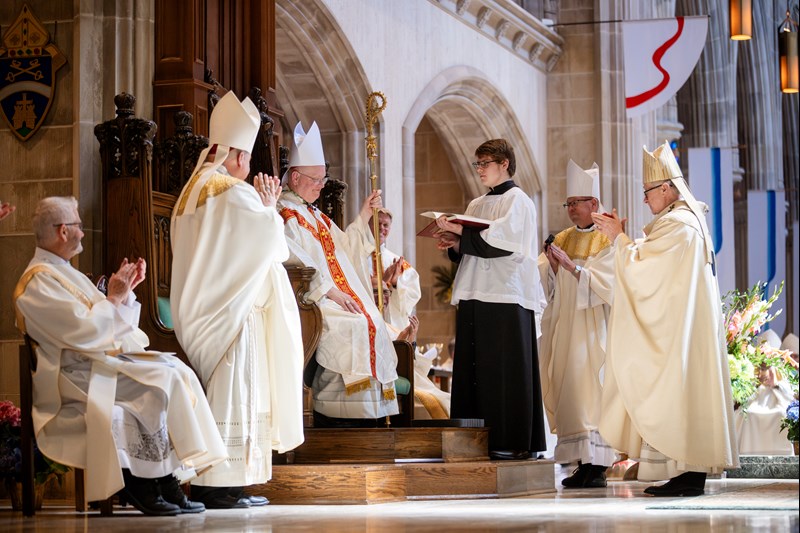
He professed vows as a Benedictine monk in 1989 and was ordained a priest in 1994. For the next 14 years, he mostly stayed on the Hill—teaching and serving in a string of administrative roles, including four years as vice rector. He also completed a Ph.D. in liturgical studies at The Catholic University of America.
He hadn’t forgotten that community meeting, or the old monk’s challenge to be a light so others know the glory of God. When Archabbot Justin DuVall, OSB, asked what he might want to do instead of his work in the seminary, he answered simply: parish ministry. He also saw a practical benefit.
“I knew that it would help my teaching,” he explains. “It would make a huge difference in the way I understand liturgical principles and how they’re applied.”
In 2012, he began 14 years of parish ministry—the first 10 years in the Diocese of Evansville, then back home in Belleville, where he served as rector of the Cathedral of St. Peter and, eventually, as diocesan administrator.
Still a Monk
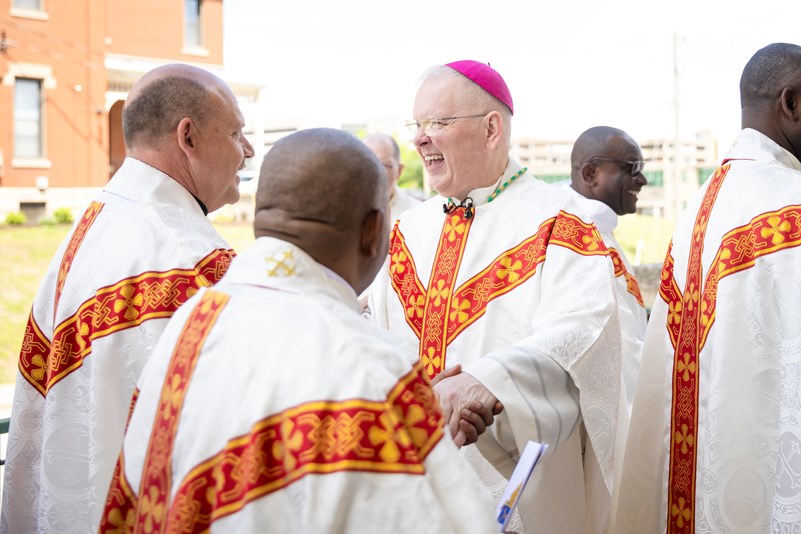
Becoming a bishop didn’t simply add a title to Bishop Godfrey’s name—it rearranged the architecture of his vows. A monk’s obedience belongs to his abbot; a bishop’s belongs to the pope. A monk’s stability is rooted in one monastery; a bishop’s is rooted in the diocese he now serves.
“My vow of obedience is now to the Holy Father, not to the abbot,” he says. “And my vow of stability is gone because I am incardinated as a priest of Belleville. The one thing I can continue is fidelity to the monastic way of life. You still use OSB, and you’re still considered a monk, but your vows are kind of suspended.”
He wants to be called by his religious name, Bishop Godfrey, rather than Bishop Mullen—a small decision that keeps him connected to Saint Meinrad. When the appointment was announced, Archabbot Kurt Stasiak, OSB, had a similar reassurance for him.
“He said, ‘You will always be a monk of Saint Meinrad to us,’” Bishop Godfrey says. “That was an important thing to me. I was very happy to hear those words. When two of your three vows are no longer fulfilled in the same way, it’s a very odd thing.”
A Vision Rooted in Stewardship
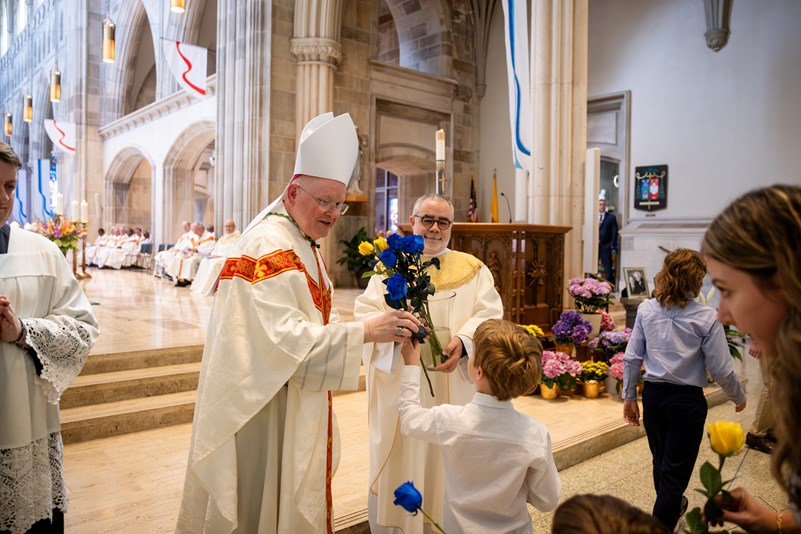
What he holds onto is fidelity to the monastic way of life. That fidelity takes shape, he says, in stewardship—a concept he watched transform parishes in Evansville and Belleville that he served in. Stewardship rests on four pillars: hospitality, prayer, formation, and service.
“If those aren’t four pillars from The Rule of St. Benedict, I don’t know what is,” he says. “It is very Benedictine in its view of the world.”
But Bishop Godfrey sees the four as really one: hospitality. “Prayer is our hospitality to God,” he says. “Formation is our hospitality to the Church’s teaching and tradition. And service is hospitality to the needs of my brothers and sisters.”
His hope for the Diocese of Belleville—99 parishes across 28 counties of southern Illinois—is to work together to build the kingdom of God.
“I think my top priority is to make sure that people know the centrality of the faith in their own lives and to help them recognize that even when life is difficult, Christ is the one who is walking with them,” he says. “He is the source of their strength.”
“We must be that light,” Bishop Godfrey says, “but sometimes people can’t come to the Hill where we live. Sometimes, the light of the Hill has to go to them.”
As bishop, that light is no longer his to carry alone into one parish. It belongs to an entire diocese.
“It’ll be my job now to help inspire that light not just in the 1,250 people at the Cathedral, but also for the whole diocese,” he says. “I look forward to how God unfolds all of this and I pray like mad that it’ll be for His good and His glory.”