When the Whole Body Works Together
Cassie Schutzer
Wednesday, July 8, 2026
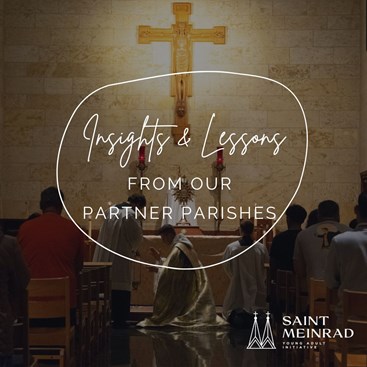
Lesson #6: Ministry is more fruitful when lay ministers and clergy work together.
Each year, we host two gathering weekends at Saint Meinrad for the parishes who are part of the Young Adult Initiative. Our seminarians are a big part of the weekend – they facilitate small groups; plan and lead our Holy Hour and prayer times; and in no small part, they make our participants feel at home while they’re on the Hill.
At one particular gathering, I was sitting in the chapel during the Saturday evening Holy Hour when I was suddenly overwhelmed by a feeling of deep joy.
This is what it looks like when the whole Body works together.
______
We had spent the whole day together – parish ministers, young adults, clergy, religious, and seminarians – listening to presentations, participating in small groups, and bonding over meals. By Saturday afternoon of the gathering, there is always a palpable feeling of community.
As each person entered, I watched as they headed to their place in the chapel.
The priests went into the confessionals to administer the sacrament; the seminarians took their places as deacon, acolyte, and server for Exposition; and the rest of the participants knelt to adore the Lord present in the Eucharist.
Each person in the chapel had a place appropriate to their vocation. Each person carried out the duties associated with their role. And the whole community was united by the Eucharist.
"This is the Body of Christ."
“This is what it looks like when the whole Body works together.”
That thought – that conviction – came from deep inside me, and I understood the beauty of our Church in a new way. I saw what it could look like if each member of the Church lives our vocation to the full, in service of one another and united in the Eucharist.
____________
I share this reflection because I truly believe that in order for our parishes to flourish, we need more collaboration between the clergy and laity.
And it’s not just a belief that I hold. The experience of our partner parishes confirms that the strength of our ministry is proportional to the degree of collaboration between laity and clergy.
Parishes with pastors who are involved in ministry – not just allowing it to happen but being present – have a lot more buy-in from young adults and acceptance from the other members of the parish. A priest who loves with the heart of Jesus is a living testimony to the people entrusted to him – and the effects of his faith are felt in the parish. If you are a pastor, I can’t tell you how much it means when you show up to events, stay a few extra minutes after Mass to hear confessions or meet new parishioners, and personally invite young adults to offer their gifts and talents to the parish community.
An involved pastor is just part of the equation; laity have a major part to play as well. As great as your pastor might be, he cannot do everything on his own. (Nor can the paid parish staff.) If you are a member of a parish, I offer this encouragement: you have no idea how much it means to our pastors when they know they’re not alone in ministry. If you have an idea for an event or program, perhaps that is the Lord calling you deeper into your own discipleship journey. Don’t be afraid to start that small group, volunteer for that service project, host that Bible study in your home, or become a catechist for OCIA.
Our pastors are there to help us grow closer to the Lord. I have yet to meet a priest who would disagree with that statement. But growing in our faith – which is best done as a community – takes a commitment from each of us. If we don’t step up and support our priests in their ministry, then we are limited by what Father can do on his own.
Each of us has a gift to share, a gift that was given to us “for building up the body of Christ.” We can only realize the fullness of the life we were created for – a life of communion – when the whole body works together as one.
________
This year, we will be diving deeper into our 2025 insights. Each month, we will focus on one lesson our partner parishes learned and offer concrete ways to incorporate these insights into your own ministry. May God bless our work!